
Google SERP
Optimise your display in Google's SERP
Good ranking and visibility requires insight into Google SERP.

Do you know how the same Google search can return different search results? It's especially annoying if you want to retrieve specific content that you have previously visited.
You remember that the content appeared on page one the last time you did the search, but now you have to go all the way to page 5 to find the same content. Why does Google choose to present you with completely different results this time, when it's the exact same keywords you entered?
The short answer is Google RankBrain.
You can learn more about what Google RankBrain is in this article. In the article, you'll also learn whether keyword strategies have become redundant and how to 'gain ground' on the search results page.
Keyword optimisation has historically been one of the most important parameters for achieving a good ranking in a search result. Previously, Google would return results for a given keyword with pages where the search robots had found the exact same keyword in your meta tags.
With Google's introduction of RankBrain, we have seen a paradigm shift that has had a major impact on how we work with SEO.
What is RankBrain?
RankBrain is an algorithm introduced by Google to gain a better understanding of keywords and the intentions that may lie behind a given search.
Being able to work out what expectations a searcher has for the result of a given search was the overriding goal with the introduction of RankBrain. Google now takes many other factors into account when deciding which results best match a given search - and not, as before, match a given keyword. These include previous searches, your geographical location or your mobile device.
Rank Brain is based on machine learning and is therefore constantly learning more about searchers' intentions. Google pays close attention to how we interact with the results we are presented with and customises search results accordingly. In particular, they are concerned with UX signals such as CTR, Dwell Time, Bounce Rate and Pogo sticking.
And here you have the answer to the initial question; the explanation is that between the first and second search, you have performed a lot of other similar searches and interacted more or longer with other pages than the one you are now trying to find. Google has learned something about you and your search intentions and is now presenting a different result based on this knowledge and your search behaviour.
CTR
Click-through-rate indicates the percentage of people who see your page in a search result and click on it.
Dwell Time
Dwell Time indicates how long a searcher stays on the page after clicking on the search result.
Bounce Rate
Bounce rate indicates the percentage of users who view only one page before leaving.
SERP
The Search Engine Results Page is the page that Google returns on your search.
Pogo sticking
Pogo-sticking is when a searcher jumps back and forth between the SERP and different results.
Snippet
A snippet is a small snippet of content from a specific URL that appears in the SERP. A standard snippet consists of a title, a URL and a description.
What does Google getting smarter mean for your SEO strategy?
Those of us who have been around since search engines first appeared on the internet will remember that it wasn't uncommon to have to expand or narrow a search many times before you got a search result that was useful. Fortunately, that's no longer the case. Now a 'lazy' searcher can type in a single keyword and be served a wide range of highly relevant search results. We can ask questions and 'think out loud' and Google is still able to return good usable results.
Of course, this change in search behaviour makes working with keyword strategies more complex than before, but by no means less relevant. It becomes more complex because we need to get 'under the skin' of searchers and identify the motives that trigger a given search, and we need to understand much more complicated Google ranking algorithms.
Let's look at a concrete example:
You've gone on a cultural trip to Copenhagen and at noon you do a Google search; "Museums in Copenhagen"
10 years ago, Google would return a result with either museums or, for example, something that talked about museums in Copenhagen - the results that ranked highest in the SERP were those that had both Museums and Copenhagen in the meta title and description for the landing page.
Today, Google also relates to unspoken needs, motives and behaviours, and the search query that Google returns an answer to today is more like; "Show museums in Copenhagen that are open; are within walking distance; offer lunch or sandwiches and sort the results according to my cultural interests".
Is a keyword strategy still relevant?
YES! Creating a keyword strategy still makes good sense in terms of your content work. And it's the quality of your content and Google's crawlers' ability to understand the context and relevance of your content that is most important for a good showing in a search result.
There's a lot you can do to help search robots understand your content better. The way you organise your content on your site has a big impact on how easily accessible it is to search engines - and of course to your visitors.
If classic keyword optimisation doesn't have such a big impact anymore, what does?
Today, a search result consists of much more than the organic results. Google uses many different ways of presenting your content, depending on the search phrase, the searcher's search history and behaviour, and the way you have made information on your website available to Google.
In the next sections, we'll take a closer look at some of the most commonly used SERP Features. SERP Features are different ways Google uses to present content that matches a search.
Google My Business
As mentioned, there are many factors that play a role in being displayed as a relevant search result on a search. In many industries, the physical location of a business or store is still an important parameter for where customers make their purchases. Therefore, Google will naturally emphasise local businesses in a search result.
One of the best ways to ensure good exposure on local searches is Google My Business.
A Google My Business profile allows your business to be highlighted on the SERP or in Google Maps with extra information not shown in a traditional snippet. In short, a Google My Business profile is a free prize in the competition for the most 'column space' that you should not ignore.
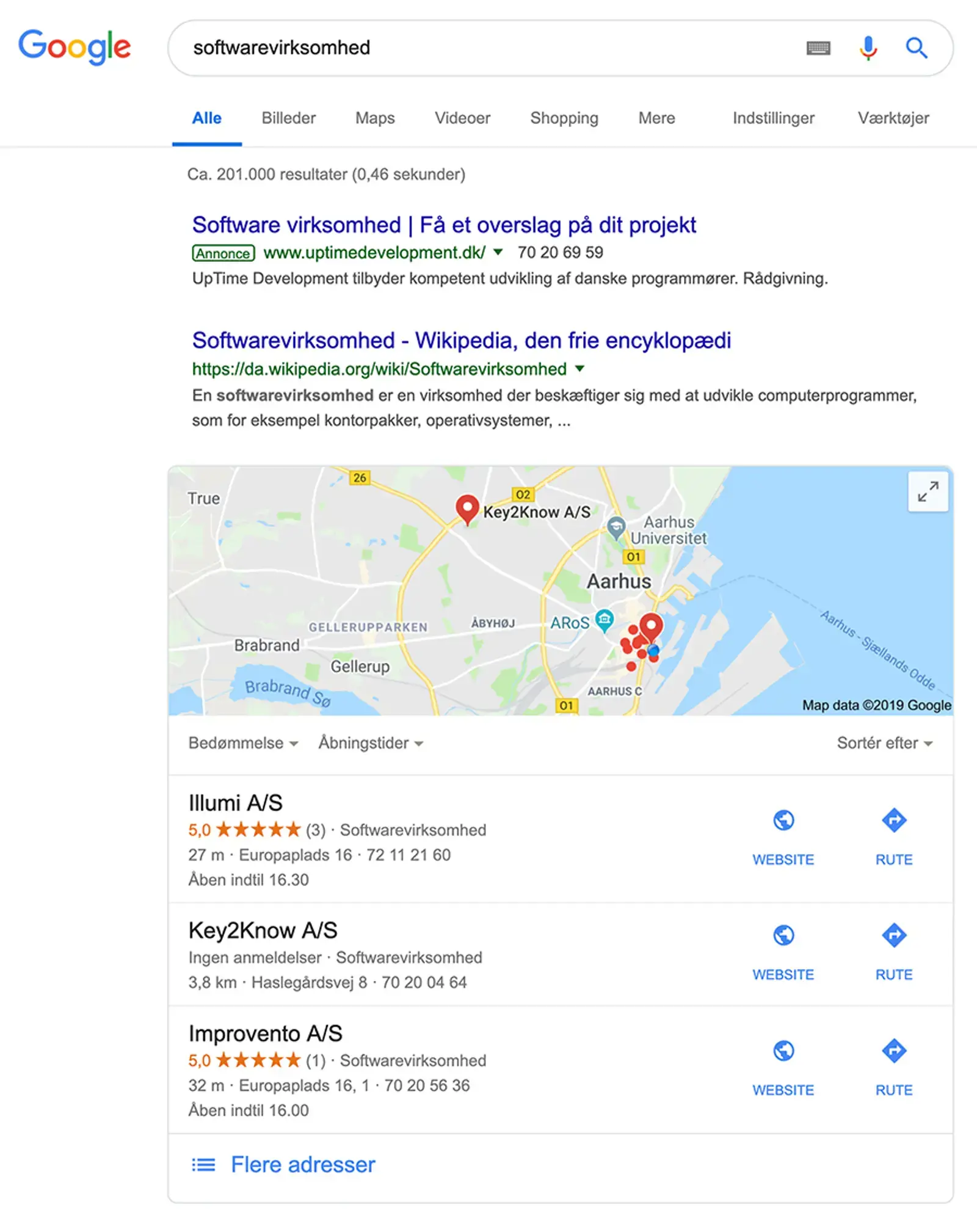
At the time of writing, we are physically located in Aarhus, and if we do a Google search for "Software company", Google returns the result below. At the top is a paid advert, followed by Wikipedia's definition of the search and then a Google Local Search result. A Local Search result is based on a company's Google My Business profile. A Local Search result is highlighted in a list and stands out significantly from the other organic search results and usually appears at the top of the SERP.
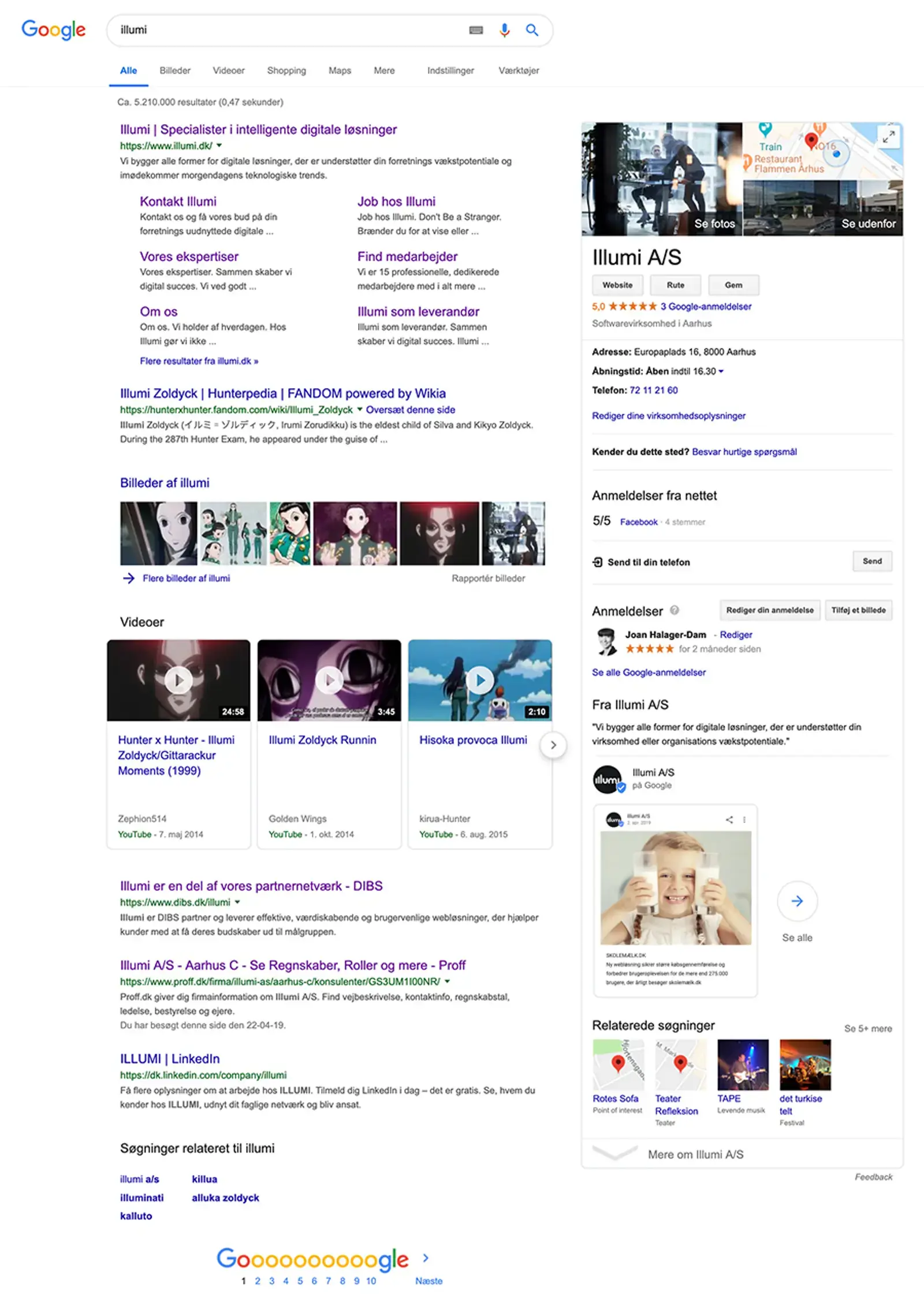
A new search for "Illumi" gives the result below. In addition to various page snippets, our Google My Business profile is displayed in the bar to the right. Here, searchers can interact with our profile content directly from the SERP and we can pique curiosity through relevant and exciting posts. The same information is exposed if I do the search in Google Maps.
Video content
YouTube is now the world's 2nd largest search engine, second only to Google. There's a very simple reason for this; we users would rather see how something works than read about it. That's why videos and images have become a natural and more integral part of the SERP.
At the top of the SERP, we often see 2-4 paid adverts followed by both video and image views. That doesn't leave much room for the organic search results. If it makes sense for your business to utilise the medium of video, it's a good idea to consider it as part of an SEO strategy.
Featured and Rich Snippets
Featured Snippets are data that Google extracts from a website and serves in a special view at the top of the SERP. The purpose is to give searchers the best chance of clicking on the right link the first time, which corresponds to the specific search.
Featured Snippets can be displayed as a text box that provides an answer or definition, for example. Featured Snippets can also be displayed as a table or a list, which you may recognise from recipes or guides. Often it is searches with specific questions that trigger a Featured Snippet.
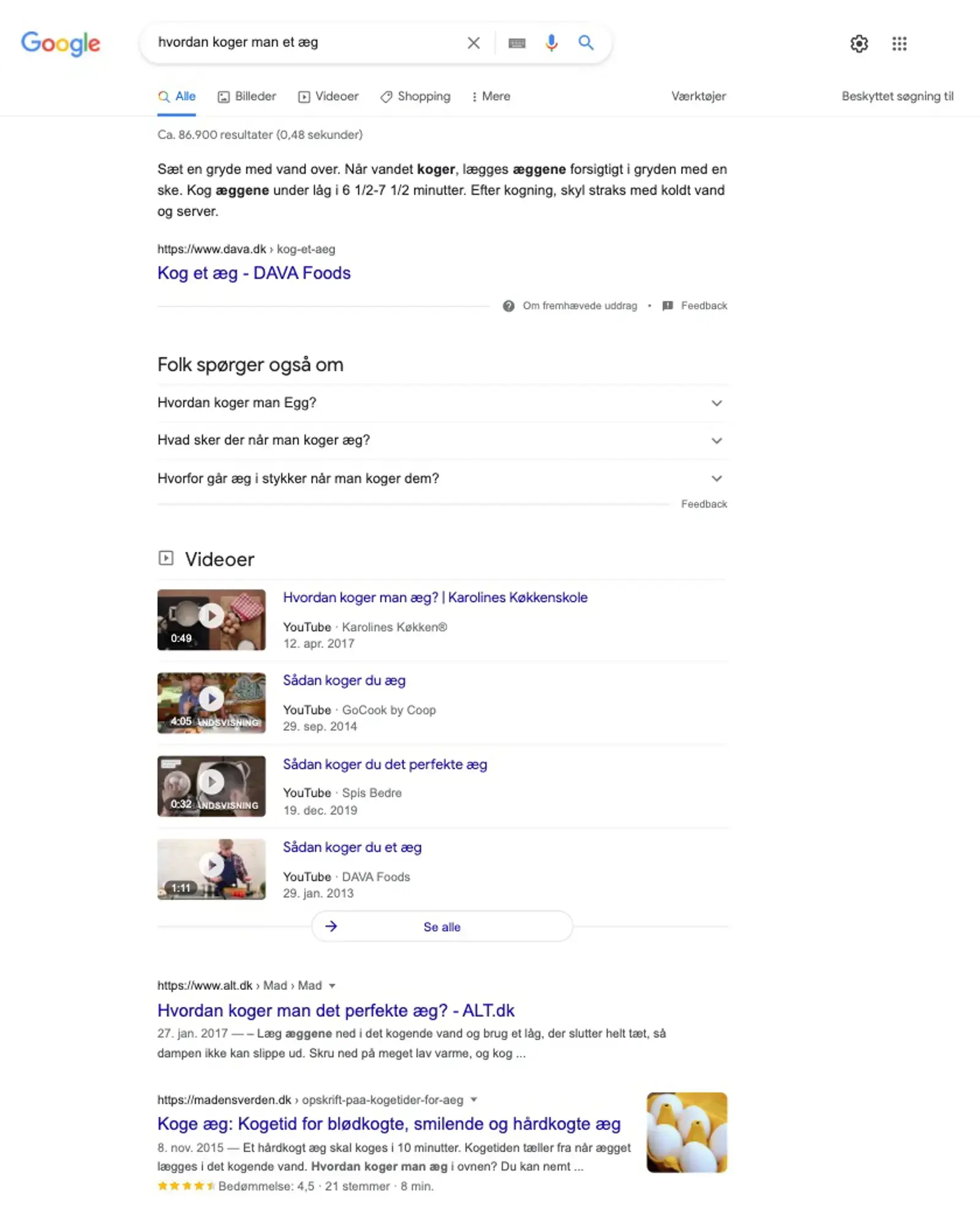
In the example below, you can see two Featured Snippets at the top of the SERP. The first is a page excerpt with instructions on how to boil an egg and the second is a list of Q&As.
At the bottom is an organic search result enriched with an image and rating.
5 tips for achieving a featured view
Unlike Rich Snippets, which you can read about in the next section, you can't code your way to a Featured Snippet view. However, there are a number of steps you can take to increase the likelihood of a selection of your content appearing as featured.
- Optimise your content to appear on page 1 of an organic search result
- Ask questions in your articles and provide an answer
- Ask the question in a header (H2 or H3)
- The answer should preferably be between 45 and 55 words
- Do a Google search for your keyword and see how Google displays featured snippets (list, table, text) and customise your content accordingly.
If you want an easy-to-digest overview of the many different featured views, you can do a Google search on 'mega SERP'. This will result in a number of infographics on the topic.
Enrich your view with Rich Snippets
Rich Snippets are additions or extensions to your regular snippet, consisting of title, url and description. There are many different types of rich snippets and what they have in common is that they enrich your snippet and set it apart from the other competitors in the search results. With the right use of Rich Snippets, you attract attention to your snippet and ultimately traffic to your content.
Rich Snippets are created from small pieces of code - also known as structured data - in your markup that tell search engines how your content is categorised and how you want it to appear.
Why should you use Structured Data?
- Because your snippet will stand out from the rest in a search result for the simple reason that there are still many websites that have not implemented structured data.
- Rich Snippet impressions take up more space in the SERP and are therefore more eye-catching.
- Rich Snippets have a much higher CTR, which positively affects your ranking.
Read more about Structured Data
What can we conclude?
What we can conclude with certainty is that the way Google delivers a search result will change as RankBrain learns more about users' search behaviour. What we can also be sure of is that the pace of change will be faster than we've seen so far.
What does this mean for our keyword strategy? Well, firstly, it means that we shouldn't think in 5-year plans but regularly rethink the way we work with SEO. It also means that we need to focus on producing quality content that provides answers to the challenges that searchers are experiencing instead of plastering our content with keywords.